














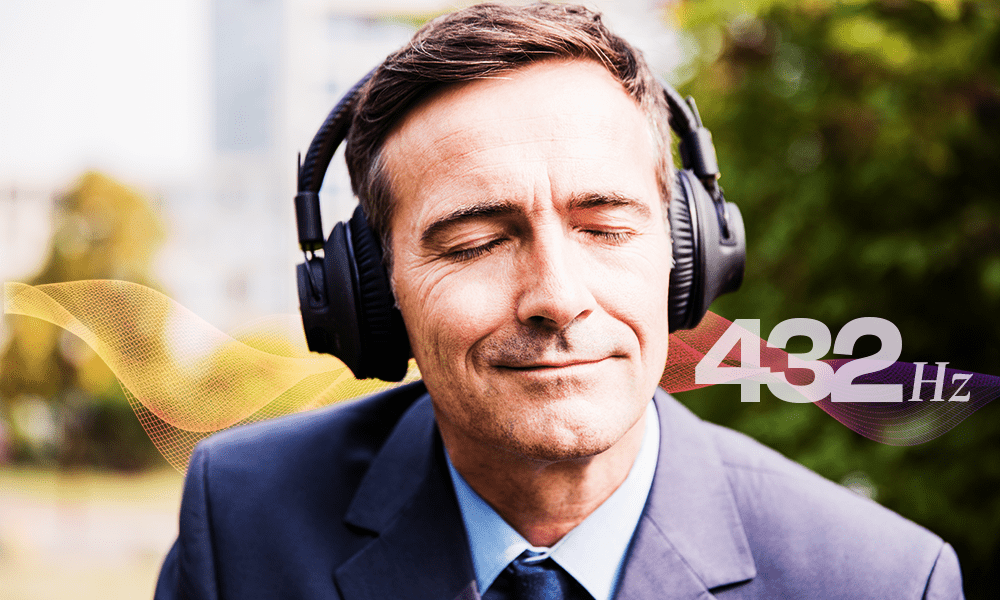
Most people discover 432Hz on YouTube or social media, often wrapped in big promises: “instant healing,” “DNA repair,” “spiritual awakening.” It sounds impressive, but it also raises a fair question: what does science actually say about 432Hz and relaxation?
In this article, we will cut through the hype and look at what researchers really know about sound, stress and the way specific frequencies influence your nervous system. By the end, you will know what 432Hz can realistically do for you, what it cannot do, and how to use it safely in your daily routine.
What makes 432Hz so special in the first place?
If you search for 432Hz music, you will find millions of views and hundreds of claims. Some say it is “the natural frequency of the universe,” others argue it is more “harmonious” with the human body than the standard 440Hz tuning used in most modern music.
There is a mix of history, myth and personal experience behind these ideas. A few composers and theorists have proposed alternative tuning systems over the last century, including 432Hz, and many listeners report that they simply “feel better” with this tuning.
The problem is that internet claims often jump from “I like how this sounds” to “this can cure your anxiety and fix your life.” That is where we need to slow down and bring in what research actually looks at when it studies sound and relaxation.
What does science really measure about sound and stress?
Most scientific studies on music and relaxation are not focused on a single magic number like 432Hz. Instead, they pay attention to factors such as:
- Tempo and rhythm
- Volume levels
- Repetition and predictability
- Harmonic content and timbre
- The way sound influences brainwaves and heart rate
Research in fields like psychoacoustics and music therapy has shown that slower, predictable, low‑to‑moderate volume sound environments can reduce markers of stress for many people. These markers include heart rate, blood pressure and self‑reported anxiety.
Some studies explore concepts like brainwave entrainment, where repetitive sound patterns are used to encourage the brain to move toward certain states, such as deeper relaxation or focused attention.
However, these studies rarely focus on “432Hz vs 440Hz” alone. They look at the whole acoustic environment and how it interacts with the listener.
Is there a real difference between 432Hz and 440Hz?
In modern music, 440Hz is the standard tuning reference for the note A above middle C. When people talk about 432Hz, they are usually talking about tuning that same A slightly lower, to 432Hz instead of 440Hz.
From a purely technical perspective, the difference is subtle but real.
The entire scale shifts slightly, which some listeners describe as “warmer,” “softer” or “less tense.” Other people do not notice any difference at all.
What we do not have is strong, consistent scientific evidence that 432Hz alone has special healing powers. The pleasant or calming response many people feel is likely a mix of:
- Personal preference
- Context (when and how they listen)
- The way the music is arranged, mixed and mastered
So while 432Hz can absolutely feel more relaxing for some listeners, it is important not to treat the number itself as a guarantee of specific health or spiritual outcomes.
Can 432Hz actually make you feel more relaxed?
The honest answer is: 432Hz can be a helpful part of your relaxation toolkit, but it is not a magic button.
Here is what we can say with integrity:
- Many people subjectively report feeling calmer and more grounded when they listen to music tuned to 432Hz, especially when it is slow, gentle and repetitive.
- The way your brain and nervous system respond to sound is real. A consistent, soothing sound environment can support relaxation, especially when you are already trying to rest or meditate.
- The exact number (432) is likely less important than the overall design of the audio: tempo, dynamics, lack of sudden changes, and a feeling of safety.
So yes, 432Hz music can support relaxation, particularly when you treat it as a tool that works together with other healthy habits, such as better sleep hygiene, reduced screen time at night and regular breaks during the day.
How to use 432Hz in a safe and realistic way
If you want to experiment with 432Hz for relaxation, here are practical guidelines that respect both your body and the science we do have:
- Start with short, intentional sessions
Choose 15 to 30 minutes in the evening or during a break. Notice how your body feels before, during and after listening. - Keep the volume moderate
Very loud sound can increase tension instead of reducing it. Aim for a comfortable level where you do not need to strain to hear, but it never feels overwhelming. - Use headphones or a calm room
For deeper relaxation, quality headphones can help you feel more immersed. For sleep, a low‑volume speaker in a dark room can work very well. - Combine with simple relaxation habits
Dim the lights, put your phone away, slow your breathing. The sound supports the environment you create, it does not replace it. - Listen to your body
If any track makes you feel uneasy, restless or overstimulated, stop. Everyone responds differently to sound. Paying attention to your own signals is part of using audio responsibly.
How Deep963 uses 432Hz to support real life
At Deep963, we do not promise miracles. We focus on giving your brain a cleaner sound environment than what you typically get from random playlists and compressed streaming.
Here is how we use 432Hz in practice:
- Our 432Hz sessions are designed for sleep, evening wind‑down and gentle emotional balance.
- Tracks are long‑form, with minimal visual stimulation, so you can stay off the screen and let your nervous system settle.
- We work with high‑fidelity audio formats, so the subtle details that support relaxation are not lost in heavy compression.
When you combine this kind of carefully designed 432Hz soundscape with your own intention to rest, focus or calm down, you give your body and mind a better chance to shift out of constant stimulation.
432Hz will not fix everything for you, but used wisely, it can become a reliable part of your routine for creating more quiet, more clarity and a deeper sense of ease in your day.